
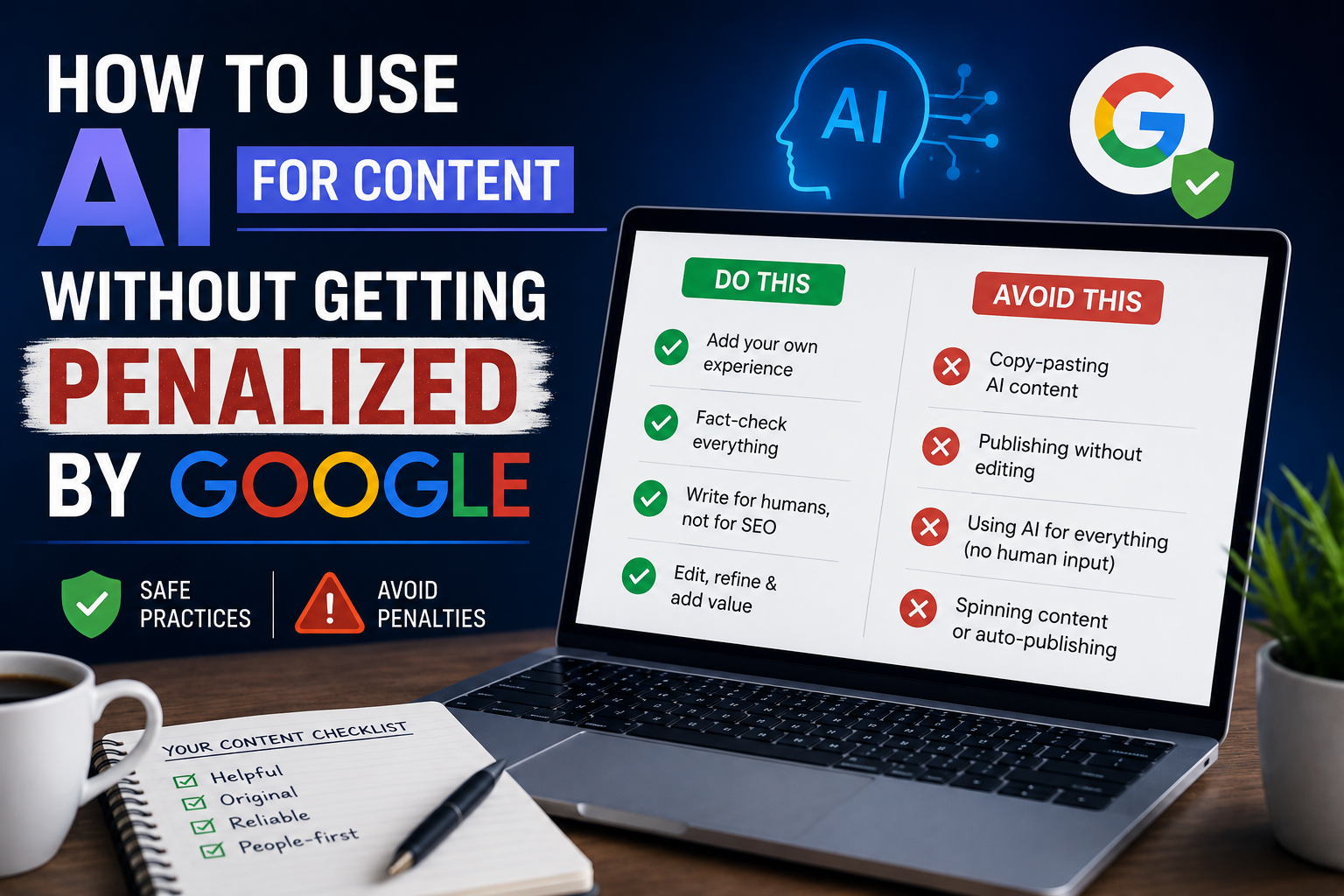
How to Use AI for Content Without Getting Penalized by Google
Google doesn’t penalize AI-generated content. It penalizes unhelpful content. Here is the exact four-step workflow that keeps AI-assisted pages ranking safely — tested across dozens of real sites.
Every week, someone publishes a new take on whether AI content will get your site penalised. Most of these takes are wrong — or at least incomplete. They either declare that AI content is perfectly safe and you should publish it freely, or they warn that Google will destroy your rankings the moment you use ChatGPT. The truth is more specific than either position.
Google does not penalise AI-generated content. Google penalises content that fails to genuinely help searchers — regardless of how it was produced. The distinction sounds small but it changes everything about how you should approach AI in your content workflow.
This guide explains exactly what Google’s policies say, what the real risk factors are, and gives you a four-step workflow that lets you use AI tools effectively without jeopardising your rankings. Every step in this workflow has been tested on real sites.
What Google Actually Says About AI Content
Before building any strategy around AI content, it helps to read what Google actually says rather than what SEO Twitter says Google says. Google has been consistent on this point since their March 2024 core update: the focus is on content quality and helpfulness, not on the method of production.
In their own words, Google’s systems aim to reward content that demonstrates EEAT — Experience, Expertise, Authoritativeness, and Trustworthiness. Those are human qualities. They cannot be faked by a language model acting alone. But they can absolutely be present in content that was assisted, drafted, or even largely written by AI — if the right human input is applied at the right stages.
The key phrase is “primarily created to help people.” This is the test. Not “was this written by a human?” but “does this content genuinely help the person who finds it?” A 4,000-word article written entirely by a human that says nothing specific, useful, or original fails this test just as badly as a poorly-prompted AI article. Google’s systems do not particularly care who or what wrote the words. They care what the words do for the reader.
What did change in Google’s recent updates is the sophistication with which their systems detect content that was produced at scale without genuine human value-add. Mass-produced, templated AI content that says the same thing across dozens of pages with no original insight, no first-hand experience, and no editorial judgment — that is what has been hit hard. And rightly so. That content is genuinely not helpful.
The Real Risks: What Actually Gets Sites Penalised
If AI content per se is not the problem, what actually triggers a Google penalty or quality demotion when people use AI? Based on patterns from sites that have been hit, there are five specific failure modes.
1 Publishing AI output without any human editorial layer
The most common mistake is treating AI output as a finished product. Raw AI content — particularly from generic prompts — tends to be accurate on the surface but empty underneath. It hits the right keywords, structures itself correctly, and sounds confident. But it lacks the specificity, the personal examples, the counterintuitive insights, and the practical nuance that come from someone who has actually worked in the area. Google’s quality raters — who evaluate content as part of how Google trains its systems — are specifically trained to spot this. They call it “lacks demonstrated expertise.”
2 Scaled content that lacks topical depth
Producing 50 articles in a week using AI and publishing them all is a signal pattern that Google’s helpful content systems now detect. It is not the volume per se — it is the surface-level treatment of topics that comes with that kind of production pace. Each page needs to fully satisfy the search intent for its specific query. That requires research, specificity, and editorial time that scaled production almost always skips.
3 No first-person experience or original perspective
The “Experience” dimension in E-E-A-T was added specifically to address AI-generated content. Google wants to see signals that the content comes from someone who has actually done the thing they are writing about. This means specific examples from real projects, opinions formed from actual results, data from your own experiments, and perspectives that contradict the obvious. AI cannot manufacture these things. You have to put them in.
4 Thin content disguised with word count
AI is very good at expanding thin ideas into long documents. A prompt like “write a 2,000-word article about keyword research” will produce 2,000 words. But much of that will be repetition, padding, and generic advice that appears in every other article on the topic. Length without depth is still thin content — it just takes longer to read. Google’s systems measure how thoroughly a piece of content satisfies the full range of questions a searcher might have. Padding does not help with that measurement.
5 Factual errors left unchecked
AI models hallucinate. They confidently state incorrect statistics, misattribute quotes, describe tools that do not exist, and get dates wrong. Publishing these errors damages your site’s trustworthiness rating — which directly affects rankings for the whole domain, not just the affected page. Every piece of AI-assisted content must be fact-checked before publication, with specific attention to any statistic, date, named tool, or attributed quote.
The 4-Step AI Content Workflow That Keeps You Safe
How to Add E-E-A-T Signals to AI-Assisted Content
E-E-A-T — Experience, Expertise, Authoritativeness, and Trustworthiness — is Google’s framework for evaluating content quality. It is not a technical metric. You cannot measure it directly in any tool. But it is what Google’s quality raters look for when they evaluate content, and it heavily influences how Google’s systems rank pages over time.
Here is how to build each E-E-A-T signal into AI-assisted content specifically:
E Experience — Add it manually, every time
Experience signals come from first-hand accounts. In every article, include at least one specific example from something you have actually done. Not “many site owners find that…” but “when I migrated a 200-page site to HTTPS last year, the one thing that caused the most indexing issues was…”. Specific, personal, verifiable details are the signal. AI cannot manufacture these. You must add them.
E Expertise — Show your reasoning, not just your conclusions
Expertise is demonstrated by showing how you think, not just what you know. Instead of stating “internal links help with rankings,” explain the mechanism: “Internal links pass PageRank — the authority signal Google calculates for every URL — from established pages to newer ones. This is why linking from your highest-traffic pages to new content is one of the fastest ways to help Google discover and rank it.” The reasoning is the expertise signal. AI often gives conclusions without reasoning. Put the reasoning back in.
A Authoritativeness — Build it at the domain level
Authoritativeness is largely a domain-level signal — it builds over time as you publish consistently on a focused topic and earn mentions and links from other sites. For individual articles, authoritativeness comes from citing credible sources, referencing your own related content, and writing with specificity and confidence rather than vague generality.
T Trustworthiness — The clearest AI-content risk
Trust is damaged the moment a reader or Google finds a factual error. AI content has a higher error rate than carefully researched human content — particularly for specific statistics, tool features, and recent events. Build trust by citing sources, acknowledging limitations and uncertainties honestly, adding a “last updated” date to articles, and including an author bio that establishes credentials.
Red Flags in Your Own AI Content — A Self-Audit Checklist
Before publishing any AI-assisted piece, run through these checks. If any item fails, fix it before the article goes live.
Which AI Tools Work Best for SEO Content in 2026
Not all AI tools are equal for content creation. The output quality, factual accuracy, and ability to follow specific formatting instructions varies significantly. Here is an honest assessment of what to use where:
1 For drafting and outlining
Claude (Anthropic) and GPT-4o (OpenAI) are currently the strongest for producing structured, well-reasoned first drafts. They follow complex prompts reliably, produce varied sentence structures, and handle nuanced topics better than earlier models. Use them with the specific prompting approach described in Step 2. Always review output — both can and do make factual errors.
2 For research assistance
Perplexity AI is particularly useful as a research tool — it surfaces sources alongside answers, making fact-checking faster. Use it to gather background research before prompting your primary AI tool, not to generate the publishable content itself.
3 For editing and clarity
After adding your human layer, use AI to tighten the draft. Prompting Claude or GPT with “edit this for clarity and remove any repetition or filler phrases” is a fast way to improve readability. This is a legitimate editorial use — you are improving your own content, not outsourcing the authorship.
4 For meta tags and titles
AI is excellent for generating title tag and meta description options. Give it your article, your target keyword, and the character limits, and ask for five variations. Pick the strongest one and adjust. This is one of the highest-ROI uses of AI in an SEO workflow.
The Bottom Line
AI is a tool. Like all tools, its value depends entirely on how it is used. A hammer used incorrectly damages things. A hammer used well builds things that last. The same is true for AI in content creation.
The sites that are thriving with AI-assisted content in 2026 are the ones that use AI to handle the parts of writing that are mechanical — structure, first drafts, meta tags, formatting — while keeping human judgment firmly in control of the parts that require real expertise and experience. The sites that are struggling are the ones that tried to remove human judgment from the process entirely.
Google’s helpful content system is specifically designed to reward the former and filter out the latter. Use the four-step workflow in this guide, add your genuine expertise, fact-check everything, and you have nothing to worry about. The risk is not in using AI. The risk is in publishing content that no human has meaningfully touched.
AI Content & Google — Common Questions Answered
Direct answers to the most common questions about using AI for SEO content safely in 2026.
No. Google does not penalize content because it was produced with AI assistance. Google penalizes content that is unhelpful, lacks genuine expertise, or appears to have been produced primarily to manipulate search rankings rather than to help readers.
AI-assisted content that demonstrates real expertise and genuinely helps readers is treated the same as any other quality content. The method of production is irrelevant — the result is what matters.
E-E-A-T stands for Experience, Expertise, Authoritativeness, and Trustworthiness. It is Google’s framework for evaluating content quality.
It matters for AI content specifically because AI tools cannot generate genuine first-hand experience or original expertise on their own. You must add those signals manually — through personal examples, specific observations, original data, and opinions formed from actual work in the subject area.
Google’s systems can detect patterns common in mass-produced AI content — particularly templated content with no original insight or first-hand experience. Well-edited AI-assisted content with added human expertise is much harder to distinguish from human-written content.
The practical implication is the same either way: focus on making your content genuinely helpful rather than trying to hide how it was produced. If it helps readers, it passes the test.
There is no percentage threshold. The question is not how much was AI-generated — it is whether the final published content genuinely helps readers and demonstrates real expertise.
Content that is 80% AI-drafted but thoroughly edited, fact-checked, and enriched with genuine first-hand insights is safer than content that is 100% human-written but vague and unhelpful. The output quality and helpfulness are what matter, not the production method.
The tool itself is not the risk factor — how you use it is. Claude and GPT-4o currently produce the most coherent first drafts for blog content. Perplexity AI is useful for research because it cites sources.
All AI tools require the same editorial process: fact-check every specific claim, add personal experience and original perspective, remove filler phrases, and ensure the content fully satisfies the target search intent before publishing.
Add E-E-A-T signals by including:
- Specific personal examples from real projects or experiences
- Opinions formed from actual results — not generic best practice
- Nuanced caveats that only someone with real expertise would know
- An author bio that establishes genuine credentials
- Citations to credible external sources for specific claims
These are the signals Google’s quality raters specifically look for when evaluating whether content demonstrates real expertise.
The most penalized patterns are:
- Mass-produced content at scale with no original insight
- Factual errors or hallucinated statistics left unchecked
- No first-person experience — content that could be written by someone who has never done the thing
- Filler phrases like “it is important to note” and “it is worth mentioning”
- Repeated information in different words to pad word count
Run through the self-audit checklist in this guide before publishing any AI-assisted article to catch these issues before they go live.