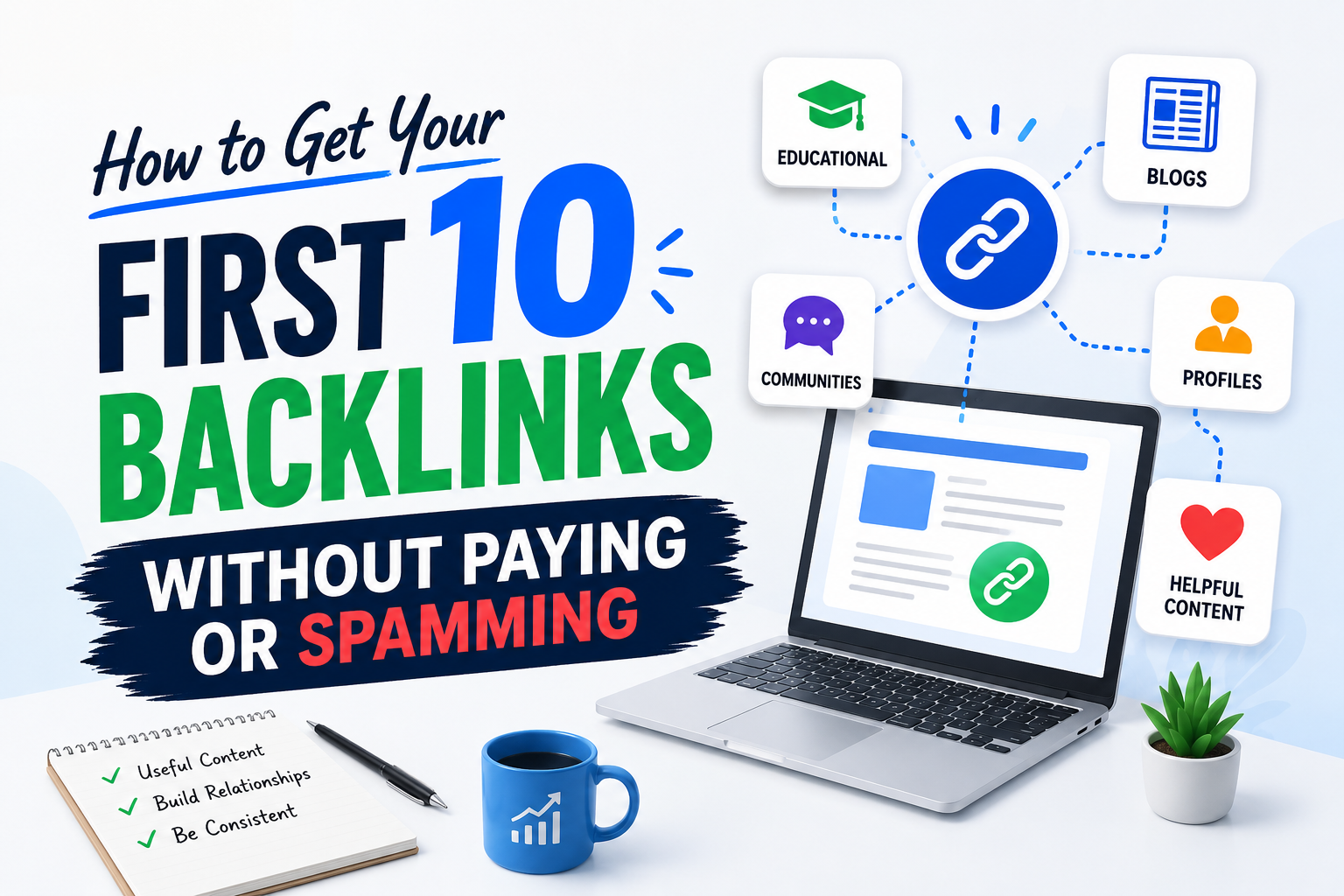
How to Get Your First 10 Backlinks Without Paying or Spamming
Ten proven methods to earn real backlinks for a new site — no paid links, no spammy directories, no tactics that get you penalised. Every method tested on real sites in 2026.
Backlinks remain one of Google’s top three ranking factors in 2026. But for a new site with no budget and no connections, earning them feels impossible. It is not — it just requires the right methods in the right order.
Every link building guide eventually tells you to “create great content and the links will come.” That is technically true and practically useless for a new site with zero traffic and zero authority. Nobody links to content they have never seen. This guide covers methods that work before you have an audience — starting with the ones that produce results fastest.
Why Backlinks Still Matter in 2026
Google’s own engineers have confirmed that links remain one of the top three ranking factors alongside content quality and RankBrain. What has changed is the quality threshold. One backlink from a relevant, authoritative site in your niche is worth more than five hundred links from random directories.
In 2026, backlinks also affect something beyond traditional rankings — AI citation. Research shows that pages with strong backlink profiles from authoritative sources are significantly more likely to appear in Google AI Overviews, ChatGPT search results, and Perplexity answers. Links are no longer just about rankings. They are also about whether AI systems consider your content credible enough to reference.
Google’s SpamBrain algorithm is highly effective at identifying manipulative link schemes. Ten genuine, relevant backlinks from real sites in your niche will move your rankings further than a hundred links from irrelevant directories. Never buy backlinks. Never use automated link building tools. The short-term gains are not worth the long-term penalties.
What Makes a Good Backlink vs a Bad One
The 10 Methods — Ordered From Fastest to Slowest
Medium is a high-authority publishing platform with a domain rating above 90. When you publish an article on Medium and use their “Import a story” feature, it automatically adds a canonical link pointing back to your original article. This tells Google that your site is the original source — and you get the backlink benefit without any duplicate content penalty.
Republish your three best articles on Medium using the import feature. Add a note at the top: “This article originally appeared on RankGrowthLab.com.” Takes thirty minutes per article. Three backlinks from a DR90+ domain in under two hours.
LinkedIn’s domain rating is above 98 — one of the highest on the internet. Publishing articles on LinkedIn and linking back to your website creates a backlink from one of the most trusted domains Google knows. More importantly, LinkedIn articles index in Google search quickly, meaning your site gets associated with LinkedIn’s authority signal.
Write a condensed 600-800 word version of your best article on LinkedIn. At the end, add: “Read the full guide with free tools at RankGrowthLab.com.” Link the text to your article. Publish once per week.
Reddit and Quora both allow contextual links within genuinely helpful answers. These are nofollow links — meaning they do not directly pass ranking authority — but they drive real referral traffic and create brand mentions that AI systems use as trust signals. One well-placed answer on a popular Reddit thread can send hundreds of visitors in a single day.
For Reddit: focus on r/juststart, r/blogging, and r/EntrepreneurRideAlong where links are permitted. Answer at least nine questions without links for every one where you include a link. For Quora: search your topic, find unanswered or poorly answered questions, write a comprehensive answer, and link to your most relevant article as a source.
Since RankGrowthLab offers free SEO tools, you qualify for listing on tool directories — sites that maintain curated lists of free resources for specific audiences. These listings typically include a dofollow backlink to your site and drive direct referral traffic from people actively looking for tools like yours.
Search Google for: “free SEO tools list site:blogger.com” or “best free SEO tools for beginners 2026” — find articles listing free tools and email the authors to suggest adding yours. Your tools are genuinely free with no signup, which makes them highly attractive for these lists.
High-authority business directories provide foundational backlinks that help establish your site’s basic authority. The key is choosing directories with real traffic and editorial standards — not mass-submission services that place your link on irrelevant, low-quality sites.
Submit to these specifically:
Help A Reporter Out was acquired by Featured.com in 2025 after a period of shutdown. The service now connects journalists from major publications with expert sources — and when a journalist includes your quote in their article, you earn a backlink from their publication. Links from news sites and industry publications carry exceptional authority.
Sign up at Featured.com as a source. Subscribe to queries in the SEO, digital marketing, blogging, and small business categories. When a relevant query arrives, respond within two to four hours with a specific, actionable answer — journalists choose the first genuinely useful response they receive. Keep your response under 150 words, answer the exact question asked, and include your name and title at RankGrowthLab.
Guest posting remains one of the most reliable link building methods in 2026 when done correctly. The concept is simple: write a high-quality article for another blog in your niche. In return, you get a backlink in the author bio or within the article itself.
Find guest post opportunities using these Google searches: “write for us” + SEO, “guest post” + blogging tips, “contribute” + SEO tools. Look for blogs with real traffic, published within the last six months, and with genuine readership — not sites that exist solely for guest posts. Your pitch should propose a specific topic they have not covered, be under 150 words, and include two writing samples from RankGrowthLab.
Broken link building involves finding links on other websites that point to pages that no longer exist — returning a 404 error — and suggesting your content as a replacement. Website owners appreciate this because you are helping them fix a problem while giving you a reason to request a link.
Use the free Check My Links browser extension to find broken links on resource pages in your niche. When you find a broken link pointing to an article similar to one you have published, email the site owner: “Hi, I noticed you have a broken link on your [page name] pointing to [broken URL]. I recently published a similar resource at [your URL] — it might be a useful replacement.” Keep it short and genuinely helpful.
Content that contains original data, statistics, or research earns links naturally — because bloggers and journalists need sources to cite. When your site publishes a statistic that does not exist anywhere else, anyone who wants to reference that fact must link back to you as the source.
For RankGrowthLab, this could be: “We analyzed 100 blog posts and found that posts with FAQ sections get 34% more clicks from Google.” You do not need a massive study — a small but genuine analysis of your own data or publicly available data is sufficient. Publish it as a standalone post, then mention it in other articles. Other bloggers will find it and link to it when writing related content.
As your site grows, other blogs and sites will mention RankGrowthLab without linking to it. These unlinked mentions are the easiest backlinks to earn — the site owner has already shown they value your content enough to mention it. They just forgot or chose not to add a link.
Set up a free Google Alert for “RankGrowthLab” and “rankgrowthlab.com” at google.com/alerts. When you receive a notification that someone has mentioned your brand, visit the page and check whether they linked to you. If not, send a short, friendly email: “Hi, I noticed you mentioned RankGrowthLab in your recent article — thank you! Would you be open to adding a link so your readers can visit the site directly?”
Your 90-Day Backlink Roadmap
The One Backlink Mistake That Kills New Sites
The most common backlink mistake new site owners make is using exact-match anchor text for every link they build. If 80% of your backlinks all use the anchor text “free SEO tools” pointing to the same page, Google’s SpamBrain algorithm flags this as an unnatural link pattern — because organic links from real sites use varied, natural anchor text.
For every 10 backlinks pointing to a page, aim for this anchor text mix: 3-4 using your brand name, 2-3 using generic text (“click here,” “this guide,” “read more”), 2-3 using partial keyword match, 1-2 using exact keyword match. This natural distribution signals organic link acquisition to Google’s algorithms.
How to Check Your Backlinks for Free
Use the free backlink checker at RankGrowthLab to monitor your backlink profile as it grows. Check it monthly to see which new sites have linked to you, identify any low-quality links that may have appeared, and track the overall growth of your domain authority. No account required.
What to Do Next
Today (30 minutes): Set up your Medium account and import your best article. Set up a Google Alert for your brand name. These two actions take under thirty minutes and set up two backlink channels that compound over time.
This week: Submit to Product Hunt with your SEO Analyzer tool. Email five resource page authors to list your free tools. Sign up at Featured.com as an expert source.
This month: Send your first guest post pitch. Answer five Reddit questions helpfully. Aim for your first ten backlinks from legitimate sources by end of month.
Backlink building is the slowest part of SEO — and the part most new site owners skip because the results are not immediate. The sites that dominate Google a year from now are the ones that started building links consistently today, even when they saw no ranking movement for the first sixty days.
Frequently Asked Questions
Common questions about getting backlinks for a new website in 2026.
There is no fixed number — it depends entirely on your niche and the competition for your target keywords. For low-competition long-tail keywords, a new site can rank with zero backlinks if the on-page SEO and content quality are strong. For more competitive terms, you typically need 10-30 relevant backlinks before seeing significant ranking movement. The focus should always be on quality and relevance rather than hitting a specific number.
Yes — for two reasons. First, Google has confirmed that nofollow links are treated as “hints” rather than completely ignored, meaning they still pass some indirect authority signal. Second, nofollow links from high-traffic sources like Reddit, Quora, and social media drive real referral traffic and create brand mentions that AI systems use as trust signals. A nofollow link from a popular Reddit thread that sends 500 visitors is more valuable than a dofollow link from a low-traffic site nobody reads.
New backlinks typically take 4-12 weeks to produce measurable ranking improvements, depending on how quickly Google crawls and processes the linking page. Backlinks from high-authority sites that Google crawls frequently — like Medium, LinkedIn, or major news sites — are processed faster than links from small blogs with infrequent crawl schedules. Submit your URL for re-indexing in Google Search Console after earning a new backlink to speed up the process.
Some are safe and some are not. High-authority directories like Crunchbase, Product Hunt, G2, and LinkedIn are completely safe and beneficial. Generic “free backlink submission” sites that promise hundreds of links instantly are almost always low-quality link farms that can trigger Google penalties. The test is simple: does this site have real human users, genuine content, and editorial standards? If yes, proceed. If it exists solely to sell or distribute backlinks, avoid it entirely.
Content first — always. You cannot build backlinks without content worth linking to, and attempting link building before you have a solid content foundation wastes everyone’s time. For a new site, publish 10-15 high-quality articles before making backlink building a significant time investment. Once your content foundation is in place, run both in parallel — publishing 2-3 articles per week while also spending 30-45 minutes per day on link building activities.