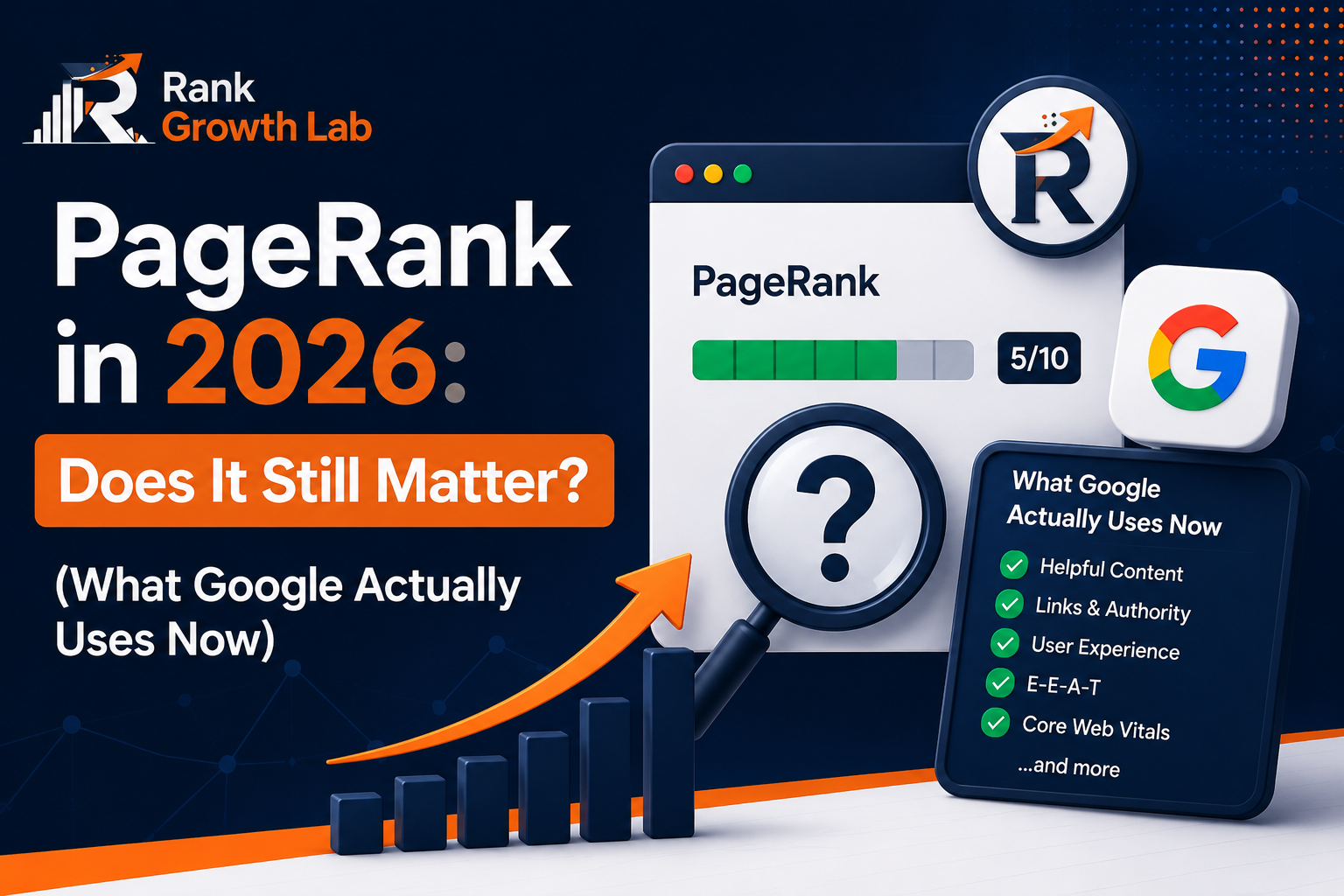
PageRank in 2026: Does It Still Matter?
(What Google Actually Uses Now)
Every blogger talks about Domain Authority. Every SEO tool shows you a DA score. But here’s the thing — Domain Authority was invented by Moz, not Google. Google has never used it. What Google actually uses — and has used since 1998 — is something called PageRank. It’s just that nobody talks about it much anymore because Google stopped showing the public score in 2016. In this guide, you’ll learn exactly what PageRank is, whether it still works in 2026, what Google actually uses to rank pages today, and most importantly — how to build it for your site without spending a single rupee.
📋 What’s In This Guide
- What Is PageRank? (The Simple Explanation)
- Is PageRank Still Used by Google in 2026?
- What Google Actually Uses to Rank Pages in 2026
- Domain Authority vs PageRank — What’s the Real Difference?
- 3 Big Myths About PageRank (Most Bloggers Believe These)
- How to Build PageRank for Your New Site in 2026
- Free Tools to Check Your Site’s Authority
- Frequently Asked Questions
1. What Is PageRank? (The Simple Explanation)
In 1998, two Stanford students named Larry Page and Sergey Brin were working on a research project about search engines. They had a simple but brilliant idea: instead of just looking at what words were on a webpage, what if a search engine looked at who was linking to that page?
Their logic was this — if 100 different websites link to your article about WordPress SEO, those 100 websites are basically voting that your article is worth reading. The more votes you get, and the more trusted the websites giving those votes are, the higher your page should rank.
They named this system PageRank — partly because of how it ranks pages, and partly because Larry Page invented it. They built Google around it, and it changed search forever.
Imagine your article is running for class president. Every time another website links to you, that’s one vote. But not all votes are equal — a vote from the most popular person in school counts more than a vote from someone nobody knows. PageRank works exactly the same way. A backlink from the BBC is worth far more than a backlink from a random new blog.
The original system gave every page a score from 0 to 10 — called a PageRank score — and Google used to show this publicly in the browser toolbar. Webmasters became obsessed with it. Then in 2016, Google removed the public score entirely. And that’s when the confusion started.
2. Is PageRank Still Used by Google in 2026?
Short answer: Yes, absolutely. The public score is gone, but the underlying algorithm is very much alive.
Google has confirmed multiple times that PageRank still runs inside their system. In fact, in a 2020 technical document, Google described how they still use link-based signals to determine which pages deserve to rank higher. They just don’t show you the number anymore.
Why did they remove the public score? Because people were gaming it — buying and selling links purely to inflate their PageRank number. By making the score private, Google made it much harder to manipulate.
Even though you can’t see your PageRank score, the links pointing to your site still matter enormously. Every quality backlink you earn is increasing your invisible PageRank score, which directly affects how Google ranks your pages. It’s just working behind the scenes now instead of being a public number.
3. What Google Actually Uses to Rank Pages in 2026
PageRank is still the foundation, but Google’s algorithm in 2026 has hundreds of signals layered on top of it. Here’s what actually matters for your rankings right now:
| Ranking Signal | How Important | What It Means Practically |
|---|---|---|
| Backlinks (PageRank) | 🔴 Very High | Quality sites linking to you = authority and trust |
| Content Quality & Depth | 🔴 Very High | Does your page actually answer the question fully? |
| Search Intent Match | 🔴 Very High | Does your content match what the person was actually looking for? |
| Core Web Vitals | 🟠 High | Page speed, visual stability, responsiveness (LCP, CLS, INP) |
| Topical Authority | 🟠 High | How many related articles on the same topic does your site have? |
| Internal Linking | 🟡 Medium-High | How well your own pages link to each other (distributes PageRank internally) |
| Site Age & Trust | 🟡 Medium | How long your domain has existed and been active |
| User Signals | 🟡 Medium | Do people click your result and stay, or immediately go back? |
Notice something? Backlinks (which are essentially PageRank) are still at the top. Content quality is right next to it. Everything else supports these two fundamentals. If your content is weak and nobody links to you, no amount of technical SEO will get you to page one for competitive keywords.
4. Domain Authority vs PageRank — What’s the Real Difference?
This is where most bloggers get confused, so let’s clear it up once and for all.
| Metric | Created By | Used by Google? | What It Measures |
|---|---|---|---|
| PageRank | Google (Larry Page, 1998) | ✅ Yes — internally | Link authority of individual pages |
| Domain Authority (DA) | Moz | ❌ No | Moz’s prediction of how well a domain might rank |
| Domain Rating (DR) | Ahrefs | ❌ No | Ahrefs’ measure of backlink profile strength |
| Authority Score | Semrush | ❌ No | Semrush’s combined authority estimate |
DA, DR, and Authority Score are third-party estimates. They’re useful for comparing your site to competitors, but Google has never confirmed using them. What all three tools are really measuring is roughly the same thing PageRank measures — the quantity and quality of links pointing to your site. So they’re useful directional indicators, just not the actual Google metric.
A site can have a DA of 5 and still rank on page one for a specific long-tail keyword. A site with DA 60 can struggle to rank for competitive terms if their content doesn’t match search intent. The number isn’t the goal — quality content with real backlinks from real sites is the goal.
5. Three Big Myths About PageRank (Most Bloggers Believe These)
“Google killed PageRank in 2016.” — When Google removed the public toolbar score, many bloggers assumed PageRank was dead. It isn’t. The public score disappeared, but the algorithm is still running. You just can’t see the number anymore.
PageRank is still Google’s foundational link authority signal. The private version is more sophisticated than ever — it’s just invisible to outsiders now, which is actually better for honest SEO.
“I need to focus on DA before doing anything else.” — New bloggers sometimes obsess over their DA score and wait to do outreach or apply for AdSense until it reaches some magic number. This wastes months of potential growth.
DA is a lagging indicator. It goes up because you’re building good content and backlinks — not the other way around. Focus on the actions (content + links), and the DA will follow on its own.
“Buying backlinks will boost my PageRank fast.” — This still gets people in 2026. Paid link schemes look great for a few weeks, then trigger a Google penalty that can deindex your entire site.
Google’s spam detection is much better than it was 5 years ago. The only sustainable way to build PageRank is earning real links through genuinely helpful content, guest posts, and being mentioned naturally by other sites in your niche.
6. How to Build PageRank for Your New Site in 2026
Here’s the thing about PageRank — you can’t buy it (safely), you can’t shortcut it, but you can absolutely build it with a consistent plan. Here’s exactly what works for a new site:
Write Guest Posts (1 per Week)
Find blogs in your niche that accept guest posts. Search Google for "write for us" + SEO or "write for us" + blogging tips. Write a genuinely useful 800–1,200 word post, and include one natural link back to a relevant article on your site. Even 4–6 guest posts in a month will start moving your positions.
Submit Your Tools to Free Directories
If you have free tools on your site, submit them to tool directories — these are high-DA sites that give you free backlinks. Try theresanaiforthat.com, futurepedia.io, toolify.ai, and alternativeto.net. Each one is a free backlink from a site with DA 50–80.
Build Internal Links Strategically
Every article you publish should link to 3–5 other articles on your site. This distributes your existing PageRank across all your pages internally — Google’s crawler follows these links and assigns authority based on them. It’s the one PageRank lever that’s 100% in your control and costs nothing. Check out our guide to internal linking for the full strategy.
Answer Questions on Quora with Links
These are technically “nofollow” links — meaning they don’t pass PageRank directly. But they still bring real traffic to your site, and that traffic signal helps Google trust your pages more. Plus, Quora answers rank in Google search results themselves, giving you more surface area.
Import to Medium with a Canonical Link
When you publish on Medium (using the import story feature), Medium automatically sets a canonical tag pointing back to your original article. This tells Google your site is the original source. Medium has a very high DA, so even canonical links help establish your site’s credibility in Google’s eyes.
Create Content Worth Linking To
The best long-term PageRank strategy is creating content so good that other people link to it naturally. Original research, detailed how-to guides, free tools, and comprehensive checklists get linked to far more than opinion posts. Every tool you publish on your site is a potential link magnet.
🎯 The Real Goal Here
You don’t need a DA of 50 to rank for the keywords you’re targeting right now. A new site with DA 5–10 can absolutely rank on page one for long-tail keywords under 2,000 monthly searches. Focus on building 1–2 quality backlinks per week, and your positions will start moving visibly within 60 days.
7. Free Tools to Check Your Site’s Authority
You can’t see your actual PageRank, but these free tools give you a solid estimate of where you stand:
Go to Links → External Links to see who is linking to your site right now. It’s the most accurate backlink data available — straight from Google itself.
Shows your Domain Rating (DR), all your backlinks, and which pages on your site have the most link authority. Verify your site ownership and get access free forever.
Check your Domain Authority (DA) score and see your top linking domains. Great for comparing your authority to competitor sites in your niche.
Shows domain score, backlink count, and which pages on your site have the most authority. Good for a quick overview without signing up for a paid tool.
For most new bloggers, Google Search Console + Ahrefs Free Webmaster Tools together give you everything you need to track your authority growth without spending anything. Start there.
Frequently Asked Questions
Yes — PageRank still exists inside Google’s algorithm. The public score disappeared in 2016, but the underlying link authority system is very much active. Getting quality backlinks still directly improves how Google values and ranks your pages. Every link you earn is building your invisible PageRank score.
For a blog that’s 0–3 months old, a DA of 1–10 is completely normal. Most blogs stay under DA 20 for their first year. DA 30+ after 12 months with consistent backlink building would be excellent. Don’t obsess over the number — focus on getting real links from real sites in your niche and the DA will follow.
Yes — especially for very long-tail keywords with low competition. New sites rank without backlinks all the time by targeting ultra-specific 4–5 word phrases with low search volume. But to rank for anything with meaningful traffic (1,000+ monthly searches), you’ll eventually need some backlinks. Even 5–10 quality links from relevant sites can make a visible difference.
PageRank is Google’s internal algorithm — real, used in search, but private since 2016. Domain Authority is Moz’s third-party score, and Domain Rating is Ahrefs’ version. Neither DA nor DR is used by Google directly, but they’re useful approximations of your site’s link strength — because they’re measuring the same underlying thing: the quality and quantity of sites linking to you.
Going from DA 1 to DA 20 realistically takes 6–12 months with consistent effort. The pace depends entirely on how many quality backlinks you earn. One guest post per week can move your DA faster than most people expect in the first 6 months. Don’t expect overnight results, but do expect steady progress if you’re building links consistently.
🚀 Ready to Start Building Authority for Your Site?
Check out our free SEO tools — no signup needed, no credit card, no nonsense. Built specifically for bloggers and indie founders who want to grow without paying for expensive software.
Explore Free SEO Tools →
Wow! Finally I got a weblog from where I be capable of genuinely get valuable facts regarding
my study and knowledge.
I got this web site from my friend who told me about this website and at the moment this time I
am visiting this web site and reading very informative posts
at this time.
Hello there! I just want to offer you a huge thumbs up for the great info you’ve got here on this post.
I will be returning to your blog for more soon.
Hi, I wish for to subscribe for this webpage to get latest updates, so where
can i do it please help.
Thanks for sharing your thoughts. I truly appreciate your
efforts and I will be waiting for your further post thanks once again.
Very nice post. I just stumbled upon your weblog and wanted to say
that I’ve really enjoyed surfing around your blog posts.
After all I will be subscribing to your rss feed and I hope you write again soon!
Hi! Do you use Twitter? I’d like to follow you if that would be okay.
I’m definitely enjoying your blog and look forward to new updates.
Post writing is also a excitement, if you know then you can write or else it
is complicated to write.
Great content! Keep up the good work!
For most recent news you have to visit world-wide-web and on world-wide-web I found this web site as a best website for most recent updates.
Keep on working, great job!
Hola! I’ve been following your web site for some time now and finally got the courage to
go ahead and give you a shout out from Dallas Texas!
Just wanted to tell you keep up the great job!
Heya i am for the first time here. I found this board and
I find It really useful & it helped me out much. I hope to give something back and help others like you helped me.