
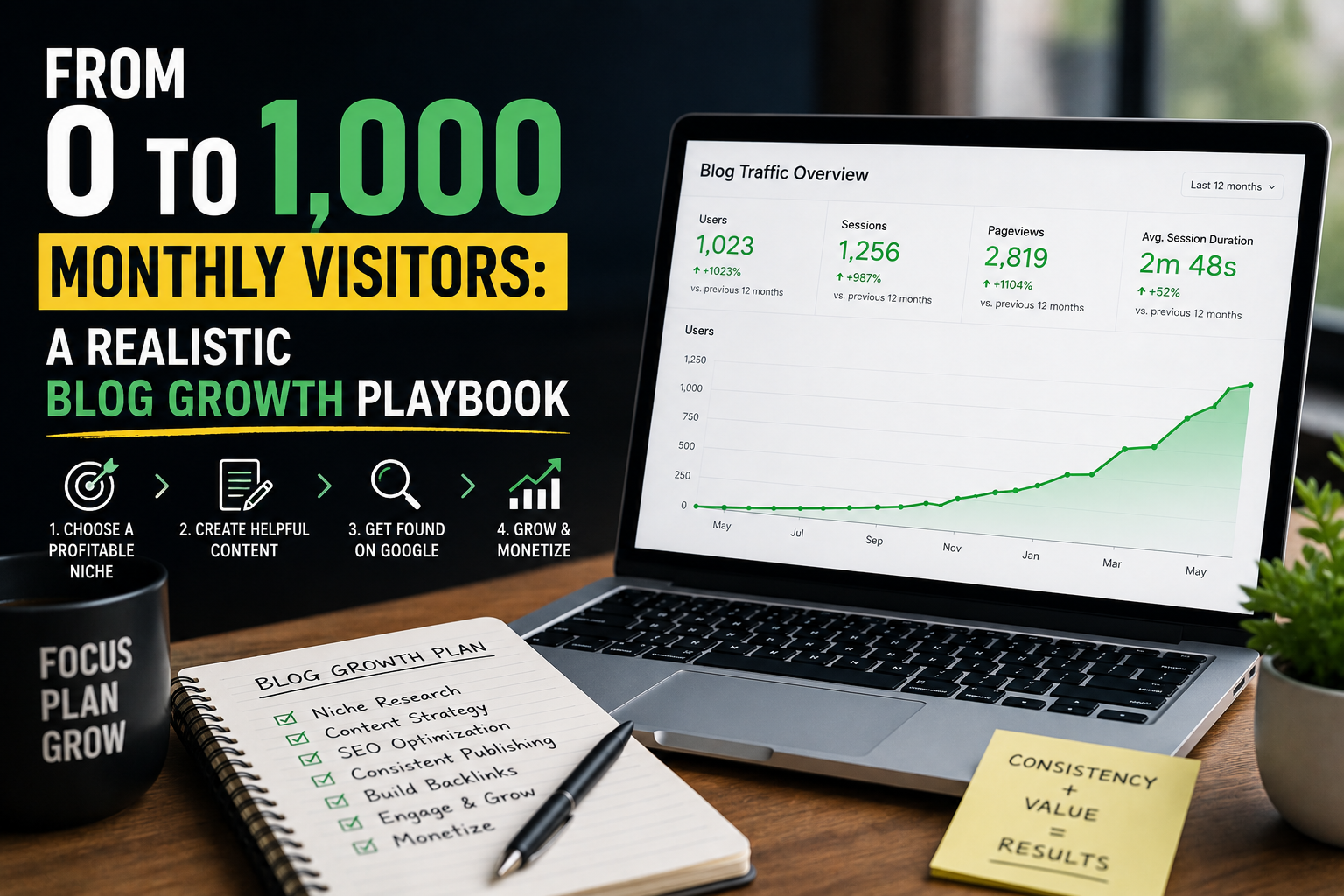
From 0 to 1,000 Monthly Visitors: A Realistic Blog Growth Playbook
The exact 90-day system to grow a brand new blog from zero to 1,000 organic monthly visitors. No paid ads, no viral tricks, no shortcuts — just a compounding strategy that actually works for new sites in 2026.
Most new blogs fail quietly. Not with a dramatic crash — just a slow silence. A few posts go up, traffic never arrives, and the site gets abandoned somewhere around month three. It happens to the majority of blogs that launch every week, and it almost always happens for the same handful of reasons.
This playbook is built specifically to help you avoid those reasons. It is a 90-day plan based on what consistently works for new sites — not on theory, not on what worked in 2019, and not on advice written for sites that already have domain authority. This is the approach for starting from zero.
One thing upfront: 1,000 monthly visitors in 90 days is achievable for most niches, but it is not guaranteed. The timeline depends on your niche competition level, how consistently you execute, and some degree of how quickly Google decides to trust your domain. What I can tell you is that every step in this plan moves you toward that number as efficiently as possible.
Why Most New Blogs Never Reach 1,000 Visitors
Before the plan, it is worth understanding what kills most blogs before they get traction. The mistakes are predictable and avoidable — but only if you know to look for them.
1 They target keywords that are impossible to rank for
A brand new domain with zero backlinks has essentially no authority in Google’s eyes. Writing about topics that established sites with thousands of backlinks have covered for years is a losing strategy in the short term. It does not matter how good your article is — Google will not rank an unknown domain over a trusted authority site for competitive keywords. New blogs must start with low-competition keywords and build from there. This is the single most important strategic decision you will make.
2 They publish inconsistently and then stop
Google rewards consistent publishing signals. A site that publishes two articles and then goes quiet for two months tells Google it might be inactive or low-effort. The first 90 days of a new blog are critically important for establishing your publishing cadence. Even publishing one solid article per week consistently is far more effective than publishing five articles in one week and then nothing for a month.
3 They write for themselves instead of for search intent
Most new bloggers write about what they find interesting rather than what people are actively searching for. There is nothing wrong with having an opinion — but if you want organic search traffic, your content needs to match what people are typing into Google. That requires keyword research before writing, not as an afterthought.
4 They ignore technical foundations
A site that loads slowly, is not mobile-friendly, or has indexing issues will not get traffic — regardless of content quality. Many new bloggers spend all their energy on writing and none on making sure their site is technically healthy enough for Google to trust and rank it.
Before You Start: The Non-Negotiable Foundations
Before writing a single article, spend the first week getting these foundations right. Skipping this step is one of the most common reasons blogs plateau — fixing technical and structural issues six months in is much harder than getting them right from the start.
Phase 1 — Days 1 to 30: Build the Foundation
01
By the end of day 30 your site should have 8–10 published articles, all pages indexed or requested for indexing, a clear internal link structure, and your first appearance in Google Search Console showing impressions — even if clicks are near zero at this stage. That is completely normal. The indexing is the win.
Phase 2 — Days 31 to 60: Build Topical Authority
02
Phase 3 — Days 61 to 90: Accelerate and Compound
03
The Full 90-Day Timeline at a Glance
Which Content Types Drive Traffic Fastest for New Blogs
Not all content types are equal for driving early organic traffic. Based on consistent patterns across new sites, these formats tend to rank faster for new domains:
1 Specific how-to guides with clear steps
How-to content targets transactional and informational queries with clear intent. Searchers who type “how to do X” want a specific answer, and a well-structured step-by-step guide satisfies that intent directly. These articles also tend to rank for featured snippets — the highlighted answer box at the top of Google results — which significantly increases click-through rate.
2 Comparison and versus articles
“Tool A vs Tool B” and “Option X vs Option Y” articles target high-intent keywords where the searcher is already deciding between two things. Competition for these keywords is often lower than broad topic keywords, and conversion rates are higher because the reader is close to making a decision. For new sites in any niche, comparison articles are an efficient early traffic source.
3 Listicles that solve a specific problem
Not all listicles are created equal. “27 ways to do X” padded with thin advice is not what ranks. But “7 specific solutions to this exact problem” — where each item provides genuine value — consistently performs well in search because it matches how people scan for information. New blogs can compete on listicles even against established sites if the content is more specific and more useful than what currently ranks.
4 Question-and-answer articles targeting PAA keywords
Google’s “People Also Ask” boxes show the exact questions people are asking around a topic. Each of those questions is a potential article. For a new blog, targeting long-tail question keywords — particularly those currently answered only in passing by other articles rather than dedicated pages — is one of the most reliable ways to get early page-one rankings.
The 5 Mistakes That Kill Blogs Before Month 3
What to Do After You Hit 1,000 Visitors
The work does not stop at 1,000. But the approach shifts. Once you have proven you can rank and attract traffic in your niche, the next phase is about depth, authority, and monetisation strategy. Here is the broad direction:
Continue publishing on your proven topic cluster, but start targeting slightly more competitive keywords now that your domain has some trust signals. Invest in improving your top 10 articles — these are your primary traffic assets and improving each one compounds your results. Start pursuing backlinks more proactively from relevant sites, podcasts, and communities in your niche.
At 1,000 monthly visitors in your niche, you are also ready to apply for Google AdSense. At this traffic level you have demonstrated that your content attracts a real audience — which is exactly what AdSense reviewers want to see. Your site is no longer brand new, it has a publishing history, and it has the trust and authority signals that come from consistent organic rankings.
Blog Growth Playbook — Common Questions Answered
Honest answers to the questions new bloggers ask most often about growing organic traffic from zero.
It is achievable for most niches but not guaranteed for every site. The timeline depends on your niche competition level, how consistently you execute the plan, and how quickly Google decides to trust your new domain.
Low-competition niches with consistent publishing can hit 1,000 visitors in 60–90 days. Highly competitive niches may take 4–6 months. The plan works — the timeline varies.
This playbook targets 20–25 published articles by day 90. But quality matters more than quantity. 10 genuinely comprehensive articles targeting low-competition keywords will drive more traffic than 30 thin articles.
Focus on fully satisfying the search intent for each keyword rather than hitting a publication count. Google cares what your content does for readers, not how many articles you have published.
The most common reasons are:
- Targeting keywords that are too competitive for a new domain
- Publishing inconsistently — Google rewards consistent signals
- Writing for personal interest rather than actual search intent
- Missing technical foundations (sitemap not submitted, pages not indexed)
Google also has a trust-building period for new domains that typically lasts 4–6 months. Two months in, most sites are just beginning to see their first impressions appear in Search Console. Keep publishing.
Not necessarily for the first 1,000 visitors. If you target low-competition keywords correctly, many pages can rank on content quality and relevance alone without backlinks.
Backlinks become more important as you target more competitive keywords beyond the 1,000 visitor milestone. For the first 90 days, focus on content quality and internal linking — they are entirely within your control and cost nothing.
Open Google Search Console and find pages sitting in positions 11–30 — these are your easiest ranking improvements. Go back into those articles and:
- Improve content depth — add sections that answer related questions
- Add more internal links from high-traffic pages pointing to them
- Optimise the title tag and meta description for a higher click-through rate
A plateau usually means Google is close to ranking your content but has not fully committed yet. Small improvements to near-miss pages often produce disproportionately large traffic gains.
Start with Google Autocomplete and People Also Ask — both are free and show real search queries. Look for keywords where the top 10 results include small blogs, forum posts, or thin articles from sites you have never heard of.
Long-tail keywords (4+ words, specific questions) are the most reliable low-competition starting point. Avoid keywords dominated by established brands like HubSpot, Forbes, or Wikipedia in the first 6 months.
Apply once you have reached or are close to 1,000 monthly visitors, have at least 15–20 quality articles published, and have all your trust pages live — About, Privacy Policy, Terms of Use, and Contact.
At that point your site demonstrates consistent publishing, real organic traffic, and the trust signals AdSense reviewers look for. Applying too early, before these signals are in place, typically results in rejection for “low value content.”