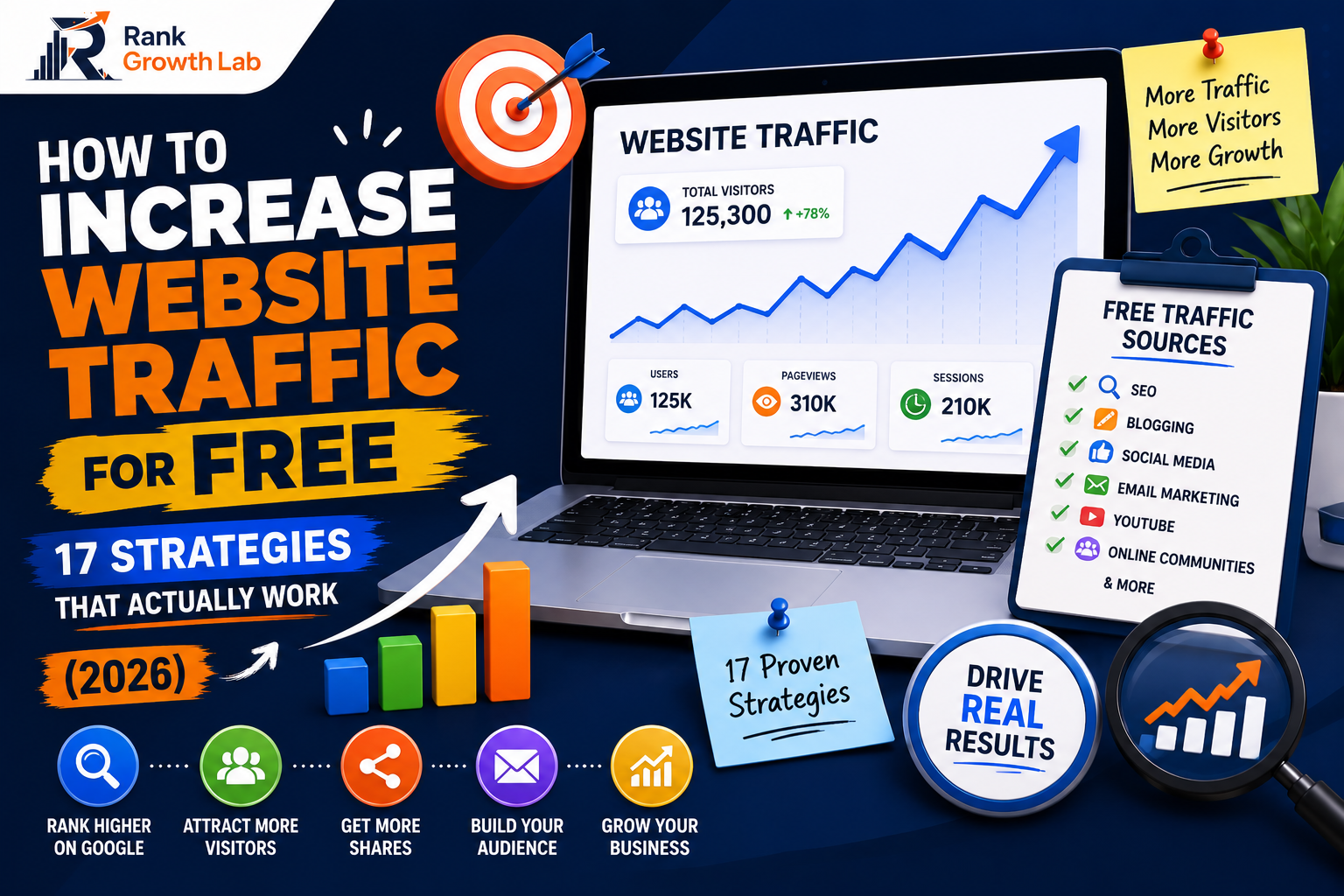
How to Increase Website Traffic for Free: 17 Strategies That Actually Work (2026)
Over 7.5 million blog posts are published every single day. Most of them get fewer than ten visitors in their entire lifetime — not because the writing is bad, but because nobody is doing the work that makes content findable. These 17 strategies change that.
I started this site with zero traffic, zero followers, zero backlinks, and zero budget. Six weeks later it was generating 2,000+ Pinterest monthly views, appearing for 100+ Google search queries, and getting visitors from seven countries. This is a documented record of exactly what worked — and in what order.
Most guides about getting website traffic read like they were written by someone who has never actually built a site from scratch. They tell you to “create high-quality content” and “build backlinks” as if those are instructions rather than vague goals. This guide is different. Every strategy here is ordered by how fast it produces results, explained with the specific actions required, and tested on real sites — not theory.
The honest reality about website traffic is this: there is no shortcut, but there is a system. Follow the system consistently and traffic compounds. Skip steps or do them inconsistently and it stalls. The difference between sites that reach 10,000 monthly visitors in six months and sites that plateau at 300 is almost never talent or luck. It is almost always process.
Bloggers, indie founders, and small business owners who want to grow website traffic without a paid advertising budget. Every tool mentioned is free. Every strategy is legitimate and Google-safe. And every timeline given is based on what actually happens — not what sounds impressive.
Why Most Traffic Strategies Fail — The Real Reason
Before the strategies, the diagnosis. Most people who fail to grow website traffic make one of three fundamental mistakes:
Mistake 1: They rely on a single traffic source. Sites that depend entirely on Google for traffic get destroyed by algorithm updates. Sites that depend entirely on social media disappear when the algorithm changes. The most resilient traffic strategies layer multiple sources so that no single change can wipe out your visitors.
Mistake 2: They target keywords they cannot rank for. A new site targeting “digital marketing tips” is not competing with other bloggers. It is competing with HubSpot, Neil Patel, and Semrush — sites with millions of backlinks and years of domain authority. The strategy that actually produces rankings is targeting four-word phrases with under 1,000 monthly searches, where the current results are beatable.
Mistake 3: They stop before the compounding starts. Traffic growth is not linear — it is exponential. Most new sites see almost no growth for three to four months, then a sudden acceleration that feels overnight but was built gradually. The people who quit in month two never see month five.
Your Traffic Sources — What to Use and When
The 17 Strategies — Ordered From Fastest to Slowest
Pinterest is the most underused traffic source available to bloggers in 2026 — and the gap between people who know this and people who do not is enormous. While everyone else waits six months for Google to trust their site, smart bloggers are getting 1,000+ monthly visitors from Pinterest within their first two weeks.
The key insight: Pinterest is not social media. Nobody browses Pinterest to see what their friends are doing. They search it — just like Google — for specific topics, tutorials, and guides. “How to start a blog in 2026,” “free SEO tools,” “WordPress setup guide” — these are real Pinterest search queries from real people looking for exactly the content you have written.
The mechanics: create vertical pins at 1000×1500 pixels using a free Canva account. Include your target keyword in the pin title and description. Link every pin directly to the relevant article on your site. Post three to five pins daily at times that match when your target audience — typically USA and UK — is most active online. For an Indian-based creator targeting Western audiences, the best posting times are 3:30 PM to 11:30 PM IST, which corresponds to early morning through afternoon in the USA.
One additional tactic that multiplies reach: join relevant group boards in your niche. Group boards have established followers and post your pins to those audiences automatically. A single group board with 5,000 followers can multiply your pin views by three to five times overnight.
We went from zero Pinterest followers to 2,000 monthly views in eighteen days using this exact approach — no paid promotion, no existing audience, no tricks.
Quora answers rank on Google independently — often on page one for long-tail questions — and they stay there for years. A single well-written Quora answer can send consistent traffic to your site every month for two or three years from a single piece of writing. That is a return on time investment that almost nothing else in content marketing can match.
The strategy is not complicated but it requires discipline: write genuinely helpful, comprehensive answers that would be useful even if you never mentioned your site. Show real expertise. Give specific advice. Then, at the end, mention your site naturally as a resource where they can learn more — only when it is genuinely relevant.
Two to three Quora answers per day in your niche is a realistic and sustainable target. Over thirty days, that is sixty to ninety answers creating sixty to ninety potential traffic sources that compound over time. The sites that generate thousands of Quora visitors per month built that result over months of consistent daily answers, not from a single viral response.
Medium’s Import a Story feature is one of the most efficient traffic and backlink strategies available to any content creator. Import your article, and Medium automatically adds a canonical link back to your original — meaning you get a backlink from a domain rated above 90 without any outreach, pitching, or relationship building required.
Beyond the backlink, Medium has its own substantial readership. Articles about SEO, blogging, and digital marketing consistently find audiences on Medium who then visit the original source. Import one article per week — starting with your most comprehensive pieces — and over two months you build ten DR90+ backlinks and reach ten additional audiences simultaneously.
The only rule: wait forty-eight hours after publishing on your own site before importing to Medium. This gives Google time to establish your site as the original source before encountering the Medium version.
This is the single most important strategic decision you will make for a new website — and most new bloggers get it completely wrong. They target broad, high-volume keywords that are dominated by established sites, get zero traffic, and conclude that SEO does not work for them. It works. They just targeted the wrong keywords.
The rule for any site under twelve months old: every target keyword must be four or more words, have fewer than 2,000 monthly searches, and have a first page of results that includes some beatable competition — smaller blogs, forum threads, or articles from 2021 that have not been updated.
“SEO tools” has 200,000 monthly searches and is unrankable for a new site. “Free SEO tools for bloggers no signup” has 300 monthly searches and is winnable. Three hundred visitors per month from a keyword you actually rank for produces more real traffic than zero visitors from one you never reach page one for.
Use the free keyword research tool at RankGrowthLab to find these long-tail opportunities — no account required. Enter your seed topic and it generates specific low-competition phrases with real search demand. For the complete keyword research process, see our keyword research guide.
You can target the perfect keyword and still never rank if your content format does not match what the searcher actually wants. This is called search intent — and Google has become extremely good at identifying mismatches between what a page offers and what the searcher needs.
Before writing any article, search your target keyword in a private browser window and study the top five results. Are they numbered lists? Step-by-step guides? Comparison tables? Your article format must match the dominant format in the results — because that format is what Google has determined best satisfies the query. A tutorial written for a query where Google shows comparison lists will not rank regardless of content quality.
This one adjustment — matching your content format to what Google already rewards for your target keyword — can improve your ranking potential more than any technical SEO change. It costs nothing, takes ten minutes of research, and fundamentally changes which of your articles will succeed.
Google does not just rank individual pages — it evaluates the topical authority of entire sites. A site with ten deeply interconnected articles all covering SEO for beginners will rank better for every SEO keyword than a site with fifty articles on random, unrelated topics.
A topic cluster works like this: one comprehensive pillar article covers the broad topic. Eight to twelve supporting articles each cover a specific subtopic in depth, and all link back to the pillar. The pillar links out to all supporting articles. Google sees comprehensive, interconnected coverage of a subject and rewards the whole cluster with elevated authority.
For our site, the SEO topic cluster includes separate articles on on-page SEO, off-page SEO, technical SEO, keyword research, meta tags, schema markup, internal linking, and Core Web Vitals — all linking to and from each other. Each individual article benefits from the authority of the whole cluster, ranking higher than it would as a standalone page.
Internal links are how Google discovers all your content and how ranking authority flows between your pages. Most beginner bloggers write articles as isolated silos with no connections between them — and then wonder why newer articles take so long to get indexed and ranked.
Every new article needs two types of internal links: links from the new article to at least three other relevant pieces on your site, and links from three existing articles back to the new article. The second type is the one most people skip — and it is arguably more important. Each internal link pointing to a page is a signal to Google that the page matters and should be crawled and ranked more aggressively.
Set a rule: before clicking Publish on any article, you must have added three links from existing articles to the new one. This single habit, applied consistently, dramatically accelerates how quickly new content gets indexed and starts ranking. The complete strategy is in our internal linking guide.
Most bloggers set up Google Search Console and check it occasionally to see if their impressions are growing. The bloggers who grow fastest use it as a weekly decision-making tool that tells them exactly where to focus their next hour of work.
The most valuable routine in GSC: go to Performance → Pages, click on any article, then switch to the Queries tab. You will see every keyword that specific article is appearing for in Google search — including keywords you never specifically targeted. Some of those keywords will have significant impressions but no clicks because your article does not specifically address them. Adding a section addressing those queries directly can move them from invisible to ranking in two to three weeks.
The position 5-15 opportunity is the fastest ranking win available to any existing site. Find any keyword where you are ranking between position 5 and 15, update that article with a section specifically addressing that query and better matching the search intent, and request re-indexing. Moving from position 12 to position 3 can multiply clicks on that keyword by five to ten times. The full guide on using GSC this way is in our Google Search Console guide.
Your title tag is your advertisement in Google search results. You can rank in position four and get fewer clicks than position seven if their title tag is more compelling than yours. Most bloggers write title tags as an afterthought — usually just the article title, unmodified, submitted and forgotten.
The formula that consistently outperforms: target keyword near the start, followed by a specific benefit or result, under sixty characters total. “On-Page SEO: Complete Beginner’s Guide to Ranking Higher in 2026” outperforms “What Is On-Page SEO and How Does It Work” on the same topic because it communicates a specific outcome, includes the year for freshness, and has the keyword first.
Go to Search Console → Performance → Pages right now. Sort by Impressions. Find your top five pages by impressions and check their CTR. Any page with over 100 impressions and a CTR under 2% has a weak title tag. Rewrite those five titles this week. The improvement in clicks typically appears within three to four weeks and requires zero new content. Use the free meta tag generator to write and check character counts.
The SEO and blogging community on Twitter/X is genuinely active, engaged, and receptive to valuable content. Bloggers who are building in public — sharing real data, real results, and real failures from their sites — consistently attract followers faster in this niche than in almost any other.
Two tweets per day is a sustainable rhythm. The first tweet can be a practical tip from your niche — a specific technique, a counterintuitive insight, or a common mistake with a direct fix. The second tweet can be a progress update from your own site — real numbers, real observations, building an audience that is invested in watching your growth.
The key distinction: do not just share links to your articles. Share the insight from the article first. Make the tweet worth reading without clicking. Then include the link for people who want to go deeper. Tweets that require a click to get value get far fewer engagements than tweets that deliver value immediately.
If your site offers free tools — SEO analyzers, keyword research tools, meta tag generators — you have access to a category of backlink that most content-only sites cannot get: tool directory listings. These are sites that maintain curated lists of the best free tools for specific audiences, and they actively seek new additions.
Product Hunt, G2, AlternativeTo, Capterra, and Crunchbase each provide a permanent, high-authority backlink and send direct referral traffic from people actively looking for tools like yours. A Product Hunt launch on a Tuesday or Wednesday can send hundreds of visitors in a single day as well as establishing a permanent DR88+ backlink.
Beyond directories, search Google for “best free SEO tools” or “free tools for bloggers” and find list articles. Email the authors with a brief, friendly pitch to add your tool. The conversion rate on these requests is high when your tool is genuinely free and useful — which is exactly the positioning of every tool at RankGrowthLab.
Core Web Vitals are a confirmed Google ranking factor. Pages that fail the LCP, INP, and CLS thresholds rank lower than pages with identical content on faster sites. This is not speculation — it is documented in Google’s own ranking systems documentation.
The fastest speed fixes available on any WordPress site require no technical knowledge and cost nothing. Install LiteSpeed Cache or W3 Total Cache — one plugin reduces load time by forty to sixty percent. Install Smush and run the bulk image optimiser — uncompressed images are the number one cause of slow WordPress pages. Check your score at pagespeed.web.dev before and after each change to see the exact impact.
Every point improvement in your mobile PageSpeed score is a potential ranking improvement across every article on your site. A site that goes from a mobile score of 45 to 85 is not just faster — it is more eligible to rank on the first page for every query it is targeting. For the full technical SEO checklist including speed fixes, see our technical SEO guide.
Schema markup is structured data that tells search engines what your content means. Adding it to your pages unlocks rich results — the expanded search listings with FAQ dropdowns, star ratings, and breadcrumbs that take up significantly more visual space than standard blue links. Pages with rich results get more clicks from the same ranking position.
In 2026, schema markup also affects AI search visibility. Google AI Overviews, ChatGPT search, and Perplexity specifically use structured data to identify content worth citing. A page without schema is at a systematic disadvantage for AI citation regardless of content quality.
With Rank Math installed on WordPress, adding Article schema to every blog post takes thirty seconds — it is automatic once configured. Adding FAQ schema to the bottom of each article (which creates expandable question dropdowns in search results) takes five minutes per article and can increase CTR by twenty to thirty percent on articles where the FAQ appears in results.
Publishing new content gets all the attention, but updating existing content often produces faster ranking improvements with less effort. An article that ranks at position 15 is already in Google’s consideration set — it just needs improvement to move into the top three. A thirty-minute update to that existing article will produce more traffic than a brand new article targeting the same topic.
The update process: go to Search Console and find any article with significant impressions but a low position. Click on that page and look at the Queries tab — it shows which keywords are triggering impressions. Add a dedicated section to the article addressing the highest-impression keyword you are not currently covering specifically. Update the publish date to signal freshness to Google. Request re-indexing. Check rankings again in thirty days.
One article updated per week alongside two new articles published per week is a more effective growth strategy than three new articles with no updates — because it capitalises on the momentum already built in existing content.
Email subscribers are the most valuable traffic source you can build — and the only one that is completely algorithm-proof. A Google algorithm update can wipe out your organic traffic overnight. A Pinterest algorithm change can eliminate your pin reach. An email list is yours forever, completely independent of any platform’s decisions.
Email subscribers also visit your site at significantly higher rates than any other traffic source. When you publish a new article and email your list, every subscriber who opens that email is a guaranteed visit. That means even a modest list of 500 subscribers produces 150-300 visits per new article — reliable, consistent, free traffic from people who specifically asked to hear from you.
The simplest setup: add a subscription form to your homepage and after every article. Use Mailchimp (free up to 500 subscribers) or your existing Contact Form 7 setup. Offer something specific in exchange for the email address — a free checklist, a guide, or simply the promise of new articles in their inbox. Start collecting from day one and the list compounds quietly in the background while you build everything else.
A guest post on a genuine blog in your niche does three things simultaneously: it earns a relevant, high-quality backlink; it exposes you to an established audience that has never heard of your site; and it builds the brand association with your niche that affects how both Google and AI systems perceive your authority.
One guest post per month is a realistic target that compounds meaningfully over time. Six guest posts over six months from sites with real audiences in your niche creates a backlink profile and brand visibility that no amount of directory submissions can replicate.
Finding opportunities: search Google for your niche plus “write for us” or “guest post.” Filter for sites that have published guest posts in the last six months and have evident real readership. Keep your pitch under 150 words, propose a specific topic they have not covered, and include two writing samples from your own site. The complete guest posting strategy is in our off-page SEO guide.
This is not a strategy in the traditional sense — it is the framework that makes all the other strategies work. Google gives new domains a trust period of three to six months during which rankings are suppressed regardless of content quality, technical SEO, or backlinks. This is documented behaviour, not speculation. It exists because Google needs time to verify that a new site is legitimate and consistently publishing valuable content.
The sites that succeed through this period are the ones that treat it as a building phase rather than a failure. Every article published, every backlink earned, every Quora answer written, every Pinterest pin posted during the trust period is laying foundations that produce results the moment the suppression lifts. The sites that quit in month two never see the rankings that their month-one work earned.
The practical implication: do not use Google rankings as your measure of success in months one through three. Use impressions (are your articles appearing in search?), Pinterest monthly views (is your content spreading?), Quora answer views (are people finding your expertise?), and email subscribers (are people trusting you enough to give you their inbox?). These metrics all move in the right direction before Google clicks do — and they are the proof that the system is working.
Google impressions growing week on week means your content is being indexed and shown in search. Impressions before clicks. Clicks before traffic. Traffic before revenue. Each stage is evidence that the next stage is coming. If your impressions are growing, you are on track — regardless of what the click count says.
The 5 Traffic Mistakes That Undo All Your Work
The Realistic Traffic Timeline
Your Free SEO Toolkit — Everything You Need
Every strategy in this guide uses free tools. Here is the complete toolkit available at RankGrowthLab — all free, no signup required:
- Free Keyword Research Tool — find low-competition keywords with real search demand
- Free SEO Analyzer — audit any page for on-page SEO issues before publishing
- Free Meta Tag Generator — write and check title tags and meta descriptions
- Free Backlink Checker — monitor your growing backlink profile monthly
What to Do Starting This Week
If you have not started yet: Do strategies 1, 2, and 3 this week — Pinterest, Quora, and Medium. These three combined can produce 200-500 visitors in your first month without any Google rankings. They are your traffic bridge while SEO builds.
If you have content but no traffic: Audit your existing articles with the free SEO analyzer. Check Search Console for impressions — if you have them, you are one title tag rewrite away from first clicks. Fix those and implement strategies 1-3 immediately.
If you have some traffic but want more: Strategy 8 — using Search Console as a weekly intelligence tool — is your fastest win. Find your position 5-15 keywords and update those articles this week. Then add strategies 14 and 15 to start compounding what you have already built.
Every large website you have ever admired was once at zero. The gap between zero and 10,000 monthly visitors is not genius or luck — it is eighteen months of consistent work across multiple traffic channels, applied methodically, without stopping. The system in this guide is the same one that has built thousands of successful blogs. It works. The only variable is whether you keep doing it long enough to see the compounding begin.
Frequently Asked Questions
Common questions about increasing website traffic for free in 2026.
Pinterest and Quora can produce traffic within days to weeks. Google SEO typically takes three to six months for a new domain due to Google’s trust period, during which rankings are suppressed regardless of content quality. Combining multiple channels — Pinterest for immediate traffic, Quora for compounding traffic, and Google SEO for long-term exponential growth — is the fastest overall strategy. Most sites using all channels simultaneously reach 1,000 monthly visitors within sixty to ninety days, and 10,000 monthly visitors within six months with consistent effort.
Quality matters far more than quantity. Ten comprehensive, well-optimised articles targeting specific low-competition keywords will generate more traffic than fifty thin, poorly optimised pieces. For Google specifically, having twenty or more articles in a coherent topic cluster signals topical authority and dramatically improves rankings across all articles in the cluster. For AdSense approval, twenty published articles is typically the minimum threshold. Aim for two to three new articles per week rather than racing to a specific count — consistent publication is more important than volume.
Yes — significantly. Pinterest is fundamentally a search engine, not a social network, and it drives traffic proportional to how well you optimise your pins for search rather than how many followers you have. In our own experience, we went from zero Pinterest followers to 2,000 monthly views in eighteen days by posting three to five optimised pins daily with keyword-rich titles and descriptions. For niches related to blogging, SEO, digital marketing, home, food, and lifestyle, Pinterest consistently produces results within weeks rather than the months that Google requires.
Yes — from Pinterest, Quora, Medium, email, and social media. These sources do not require backlinks to generate traffic. For Google SEO specifically, low-competition long-tail keywords can rank with zero backlinks if the on-page SEO and content quality are strong — particularly on sites that have been live for more than six months. Backlinks become increasingly important as you target more competitive keywords. Building them via Medium imports, directory listings, and eventually guest posting is part of a complete strategy, but it is not the prerequisite for initial traffic growth.
Consistency across multiple channels over a sustained period. No single tactic produces transformational traffic results in isolation. A site that posts on Pinterest every day, answers two Quora questions daily, publishes two SEO-optimised articles per week, imports one article to Medium per week, and posts on Twitter twice daily will reach 10,000 monthly visitors within six months. A site doing all of these things for two weeks and then stopping will not. The compounding effect of consistent, multi-channel effort over six months is the single most reliable path to significant organic traffic growth.