Off-Page SEO: The Complete Beginner’s Guide to Building Authority in 2026
On-page SEO tells Google what your site is about. Off-page SEO tells Google whether to trust it. This guide covers every method for building real authority — from backlinks and brand mentions to AI search signals — without paying for links or using tactics that backfire.
I spent three months publishing genuinely good content and watching it sit on page five of Google. The writing was solid. The on-page SEO was correct. The keywords were right. But the site had no authority — and Google had no reason to trust it yet. This guide is about fixing that problem systematically.
Off-page SEO is the part of search engine optimisation that happens away from your own website. While on-page SEO is entirely within your control — you write the content, set the meta tags, configure the schema — off-page SEO depends on how the rest of the web responds to what you have built. It is fundamentally a credibility problem. Google is not just asking “is this page relevant?” It is asking “does the internet trust this source enough to send people there?”
The answer to that question comes from signals that live outside your site: links from other websites, brand mentions across the web, how often people search for you by name, whether journalists cite you as a source, and increasingly in 2026 — whether AI systems reference your content. This guide covers all of it.
On-page SEO without off-page SEO is a great restaurant with no reviews and no sign outside. Off-page SEO without on-page SEO is a famous restaurant that serves bad food — the attention brings people in once, and the experience drives them away. Both are essential. Fix your on-page SEO first. Then build authority here.
Why Off-Page SEO Changed Dramatically in 2026
The off-page SEO playbook from 2020 — build as many backlinks as possible, use exact-match anchor text, submit to directories — does not just fail in 2026. It actively harms rankings. Google’s SpamBrain algorithm has become significantly more effective at identifying manipulative link patterns, and the penalties for unnatural link profiles are real and lasting.
What has replaced the old playbook is something more interesting and, for genuine content creators, more rewarding: authority building. The sites that are climbing in 2026 are not the ones with the most links. They are the ones that the internet genuinely talks about, references, and searches for by name.
Three shifts define the 2026 off-page landscape specifically:
AI systems now amplify off-page signals. Google AI Overviews, ChatGPT search, and Perplexity all use off-page authority signals to decide which sources to cite. A site with strong brand mentions and high-authority backlinks gets cited in AI answers. A site with no off-page presence gets ignored — regardless of content quality. Off-page SEO now determines AI visibility, not just Google rankings.
Brand signals have become primary signals. Former Google CEO Eric Schmidt once said “Brands are the solution, not the problem.” That statement has aged extremely well. In 2026, Google explicitly rewards sites that behave like genuine brands — consistent identity, recognisable name, stable traffic patterns, branded searches. The off-page strategies that work best are the ones that build brand recognition alongside link equity.
Quality thresholds have risen sharply. One backlink from a relevant, respected site in your niche now outweighs fifty links from unrelated directories. The quality bar for what counts as a useful link has risen to the point where low-quality link building often produces negative results rather than neutral ones.
The 5 Off-Page Signals Google Actually Uses in 2026
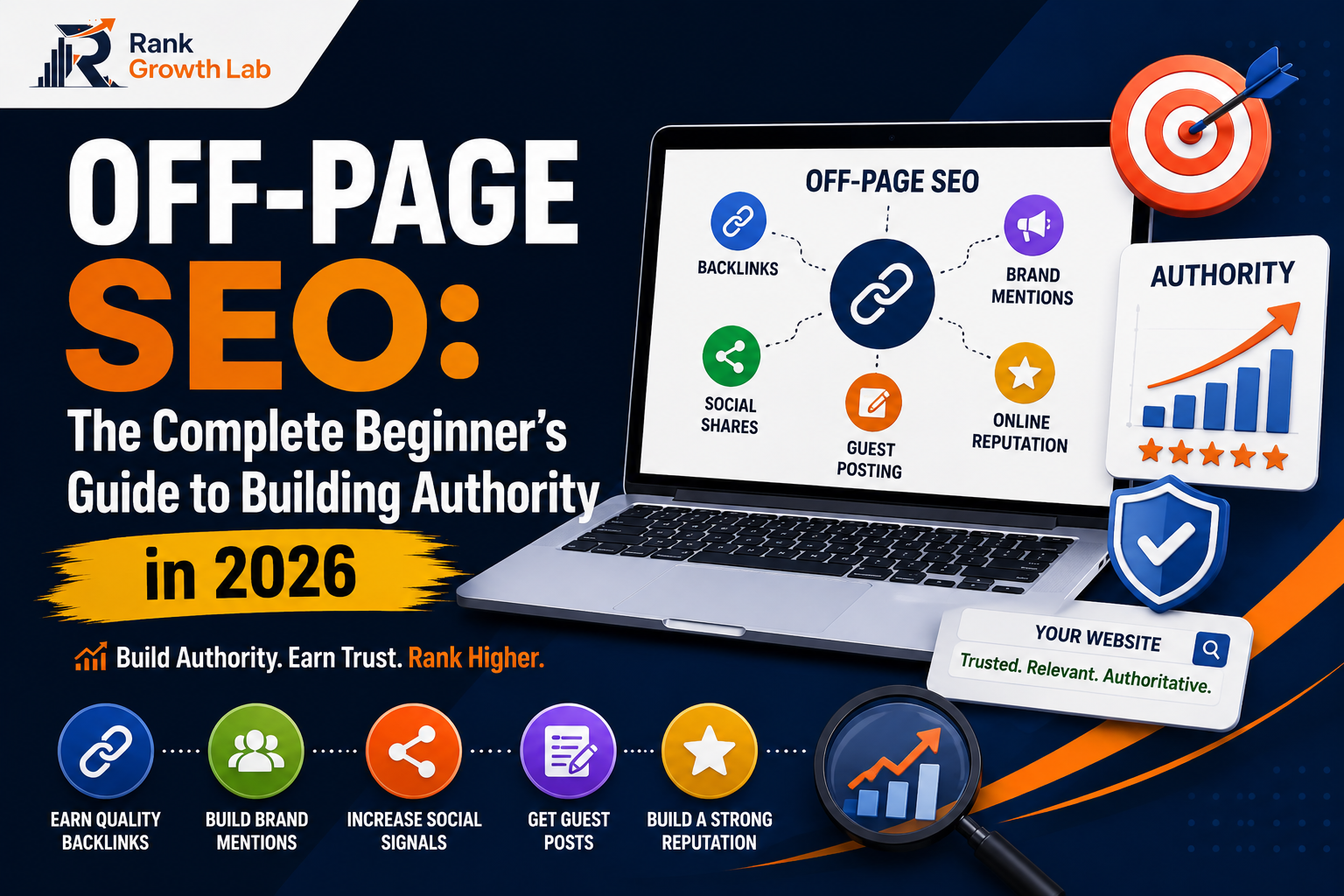
Before the strategies, understand what you are actually trying to build. Google evaluates off-page authority through five primary signal types:
Backlinks remain the most powerful individual signal. Brand mentions — even without a hyperlink — have become a meaningful trust signal that Google can now read and interpret. Branded searches (people typing “Rank Growth Lab” directly into Google) signal that your brand has independent recognition. Social signals are indirect — they do not directly affect rankings, but content that gets widely shared tends to attract the links and mentions that do. Reviews affect local and business trust signals.
The Off-Page SEO Myths That Waste Your Time
The 8 Off-Page SEO Strategies That Actually Work in 2026
This is the fastest legitimate backlink method available to any new site — and almost nobody takes full advantage of it. Medium has a domain rating above 90. LinkedIn’s is above 98. When you publish content on these platforms and link back to your site, you earn a backlink from one of the most trusted domains Google indexes.
For Medium specifically, use the Import a Story feature rather than writing original content. Import your best existing article — Medium automatically adds a canonical link pointing back to your original post, which means Google credits your site as the source while you still get the backlink benefit. No duplicate content penalty. No extra writing time. Three DR90+ backlinks in an afternoon by importing your three best articles.
For LinkedIn, create a company page for your brand and publish condensed versions of your best articles — 600 to 800 words — with a link to the full article at the end. LinkedIn articles index in Google within days and the backlink from a DR98 domain creates a meaningful authority signal. One LinkedIn article per week is a low-effort, high-impact off-page activity.
Substack is the underrated one here. Its domain rating is climbing rapidly and its audience is actively engaged — readers who find your content there and subscribe are significantly more likely to share it and link to it from their own sites later.
What to import first
Start with your most comprehensive article — the one that covers a topic most thoroughly. That is the piece most likely to attract readers who have their own websites and might link to it naturally over time. Import your top three articles in the first week, then continue one per week.
If your site offers any free tool — even a simple one — Product Hunt is one of the best backlinks available and completely free to obtain. Product Hunt’s domain rating is above 88, it has significant daily traffic from tech-savvy early adopters, and a successful launch day can send hundreds of direct visitors as well as the permanent backlink.
The strategy is straightforward: create a Product Hunt account, go through the submission process for your tool or site, and launch on a Tuesday or Wednesday when the platform sees highest engagement. Write a clear, specific tagline about what problem your tool solves. Add screenshots and a direct link to your tool page.
Beyond Product Hunt, submit your free tools to these directories — each provides a legitimate, relevant backlink:
- G2.com (DR 91) — list your tools in the free SEO software category
- AlternativeTo.net (DR 82) — list as a free alternative to Ahrefs or Semrush
- Capterra (DR 89) — submit to the free SEO tools category
- Crunchbase (DR 90+) — create a company profile with your website URL
- There’s An AI (DR 70+) — submit your AI-powered tools specifically
Each of these takes twenty to thirty minutes to set up and produces a permanent, relevant, high-authority backlink. Do all five in one afternoon and you have five backlinks from DR70+ domains before doing any outreach at all.
Guest posting has survived every Google algorithm update since 2012 for a simple reason: when done correctly, it is genuinely useful for readers. A well-written guest post that actually helps the host site’s audience is not a manipulation — it is a fair exchange of value. The host gets quality content. You get a relevant, contextual backlink and exposure to a new audience.
The key phrase is “done correctly.” The guest post farms that dominated early SEO — sites that existed purely to publish sponsored posts with keyword-stuffed anchor text — are now actively penalised. What works is identifying genuine blogs in your niche that have real audiences, proposing a specific topic that their readers would benefit from, and writing something better than what they would have published without you.
How to find guest post opportunities
Search Google for: your niche + “write for us”, your niche + “guest post”, your niche + “contribute”. Filter results for sites that have published guest posts in the last six months — older programmes may be inactive. Look for sites with real traffic (check their content for engagement signals — comments, shares, visible audience), not sites that exist purely for link selling.
The pitch that gets accepted
Keep it under 150 words. Propose one specific topic they have not covered — check their archive to confirm. Include two links to writing samples from your own site. State clearly what their readers will learn. Do not mention SEO, links, or anchor text in your pitch — the best guest posts are proposed as content contributions, not link building exercises.
What to include in the post itself
Write for the host site’s audience first. One natural link back to a specific, relevant article on your site within the body content. Author bio with your name and a link to your homepage. No keyword-stuffed anchor text — use natural phrases like “our keyword research guide” rather than “free keyword research tool no signup 2026.”
A single mention in a major publication — Forbes, Business Insider, a respected industry blog — produces more ranking authority than fifty directory backlinks. The domain ratings of major publications are in the 80s and 90s. The editorial standards mean Google trusts them as genuine citation sources. And unlike most link building, these citations can send real referral traffic for months after the article is published.
Featured.com (which acquired HARO in 2025) connects journalists from major publications with expert sources. The process: journalists post queries asking for expert perspectives on specific topics. You respond with a concise, specific answer. If the journalist uses your quote, you get cited — typically with a link — in their published article.
How to use Featured.com effectively
Sign up at featured.com as a source — free account. Set up email alerts for topics in your niche: SEO, blogging, digital marketing, content strategy, small business. When a relevant query arrives, respond within two to four hours. Journalists typically choose from the first genuinely useful responses they receive.
Your response should be under 150 words, answer the exact question asked rather than giving generic advice, and include a specific data point or personal observation where possible. End with your name, title, and site. Never mention wanting a link — the journalist will include attribution as a matter of professional practice.
One accepted response per month from this process is realistic for a new site. Over six months, that is six editorial backlinks from major publications — an off-page foundation that takes competitors years to replicate.
Broken link building is one of the few link building strategies where you are genuinely helping the site you are contacting. Every website has broken links — links that once pointed to live pages but now return 404 errors. Finding those broken links and suggesting your relevant content as a replacement is a mutually beneficial exchange: you get a backlink, they get a fixed link.
The broken link process
Install the Check My Links Chrome extension — free. Visit resource pages in your niche: “best SEO resources” pages, “tools for bloggers” lists, any page that links to multiple external sources. Run Check My Links and look for red-highlighted broken links. When you find one pointing to a topic you have covered, email the site owner.
The email should be short and specific: “Hi [name], I noticed a broken link on your [page name] — it’s pointing to [broken URL] which now returns a 404. I recently published a similar resource at [your URL] that might work as a replacement. Either way, hope this helps.” That is it. No lengthy pitch. No mention of wanting anything in return. Many site owners will simply replace the link as a matter of maintenance.
Resource page outreach
Search Google for: your topic + “useful resources”, your topic + “helpful links”, your topic + “resource page”. These pages list links to external content on a given topic — and if your content belongs on the list, a short, friendly email can earn you a placement. The pitch is even simpler than broken link outreach: “Hi [name], I found your [page name] and thought you might want to know about [your resource]. It covers [specific angle] that I didn’t see on your list. Happy to send more details if useful.”
Community participation is the most misused off-page strategy. Most people treat it as a link dumping exercise — find a question, post an answer with their link, leave. This approach gets links removed, accounts banned, and does nothing for authority building because the links are flagged as spam before they can pass any signal.
The correct approach is to participate as a genuine community member who happens to have a website. Answer questions completely without the link first. Establish that you know what you are talking about. Then, when it is natural and genuinely relevant, mention your site as a resource — not as a self-promotion but as something that would actually help the person who asked.
Quora — the highest-value community platform for off-page SEO
Quora answers rank on Google independently — often on page one for long-tail questions. A well-written Quora answer on a popular question can send consistent traffic for years from a single piece of writing. The links are nofollow, but the referral traffic and brand visibility they generate create the conditions for future editorial links.
Answer two to three questions per day in your niche. Write genuinely comprehensive answers — not bullet lists, but real explanations that demonstrate expertise. Include your site link naturally in one of every ten answers. The other nine build your account credibility so Quora’s algorithm promotes your answers further.
Reddit — high traffic, strict rules
Reddit’s rules around self-promotion are strict and inconsistently enforced. The safe approach: participate in relevant subreddits for several weeks before mentioning your site. Build karma by answering questions helpfully without any links. When you do include a link, make sure the answer would be excellent without it — the link is supplementary, not the point.
For subreddits that explicitly allow links (r/juststart, r/blogging, r/EntrepreneurRideAlong), a single helpful answer that happens to mention your free tools can send hundreds of visitors in a single day. One spike like that can produce enough brand awareness to generate additional backlinks from bloggers who find your content through Reddit.
This is the strategy that most SEO guides do not cover clearly — and it is increasingly the differentiator between sites that plateau and sites that keep climbing. Brand signals are how Google determines whether your site represents a genuine brand rather than a content farm trying to game rankings.
The clearest signal of a genuine brand is branded search — people typing your brand name directly into Google rather than discovering you through a query. When enough people search “Rank Growth Lab” independently, Google interprets it as evidence that the brand has recognition beyond search manipulation. This is a quality signal that cannot be faked through link building.
How to build branded search volume
Consistent presence across platforms — Twitter/X, Pinterest, Quora, Medium, LinkedIn — means more people encounter your brand name in different contexts. When someone sees “Rank Growth Lab” in a Quora answer, then sees a Pinterest pin from the same brand, then sees a tweet — the name starts to feel familiar. Familiarity drives branded searches. Branded searches drive trust signals. Trust signals drive rankings.
Knowledge Graph and entity optimisation
Google’s Knowledge Graph is its database of real-world entities. When Google recognises your brand as an entity — with consistent name, description, and associated URLs across multiple platforms — it treats your site with higher baseline trust. Build this by: keeping your brand name identical across all platforms, completing the Organisation schema on your homepage via Rank Math, creating a Crunchbase profile, and maintaining consistent brand descriptions everywhere you publish.
Unlinked brand mention monitoring
Set up a free Google Alert for your brand name at google.com/alerts. When someone mentions your brand in an article without linking to it, email them and request a link. The conversion rate on these requests is high — the person already thinks well enough of your brand to mention it. Adding a link is a small additional step for them and a meaningful authority signal for you.
This is the newest and most underappreciated dimension of off-page SEO in 2026. Google AI Overviews, ChatGPT search, and Perplexity now appear at the top of search results for millions of queries — and they choose which sources to cite based on a combination of traditional authority signals and a new layer of criteria: how often a brand is mentioned positively across the web, whether the content has been cited by other trusted sources, and whether the entity is well-defined enough for AI systems to identify and recommend.
Research shows that sites appearing in AI search results get disproportionate click-through rates — being cited in an AI answer is effectively a position zero result. The off-page strategies that build AI authority are the same ones that build traditional authority, but with additional emphasis on:
- Positive brand mentions across diverse sources — AI systems learn from mentions, not just links. Consistent positive mentions across Quora, Reddit, Medium, and industry blogs teach AI systems to associate your brand with expertise.
- Editorial citations from established publications — when a known publication cites your content, AI systems weight that citation heavily when building their recommendation models.
- Schema markup on every page — AI systems read structured data to understand what your content is about and who created it. Pages without schema are harder for AI to classify and recommend.
- Consistent entity information across platforms — your name, description, and URLs should be identical everywhere you exist online. Inconsistency makes entity recognition harder for AI systems.
The practical implication: every Quora answer you write, every Medium article you publish, every guest post you place — these are not just link building activities anymore. They are teaching AI systems who you are and whether you can be trusted as a source. Off-page SEO and AI optimisation are converging into a single discipline.
What Makes a Good Backlink vs a Bad One in 2026
| Factor | Good backlink | Bad backlink |
|---|---|---|
| Relevance | Same niche or related topic | Completely unrelated site |
| Site quality | Real traffic, genuine content | No traffic, thin or spun content |
| Link type | Contextual within article body | Footer, sidebar, or widget link |
| Anchor text | Natural, varied, descriptive | Exact-match keyword repeated |
| How acquired | Editorial — site chose to link | Paid for or part of link scheme |
| Domain authority | DR 40+ from real publication | DR 5 from link farm or PBN |
| Follow status | Dofollow from trusted source | Dofollow from spammy network |
The 6-Month Off-Page SEO Roadmap
The Complete Off-Page SEO Checklist
How to Check Your Off-Page SEO Progress for Free
Three free tools give you a complete picture of your off-page authority growth:
Use the free backlink checker at RankGrowthLab to monitor your growing backlink profile. Check monthly — it shows which new sites have linked to you, the authority of each linking domain, and how your total link count is growing. No account required.
Go to Performance → Queries and filter by your brand name. Branded search volume appearing in GSC is one of the clearest signals that your off-page brand building is working. Even three to five branded searches per day is a meaningful signal for a new site.
Go to google.com/alerts and set up alerts for your brand name and your site URL. Every time you get mentioned anywhere on the web, you will receive an email notification. This tells you who is talking about you, whether they linked, and whether you need to reach out to convert an unlinked mention into a backlink.
What to Do Next — Starting This Week
If you have not started off-page SEO yet: Import your three best articles to Medium today. Create a Crunchbase profile tomorrow. Set up Google Alerts for your brand name right now — it takes ninety seconds. These three actions cost nothing, take under an hour combined, and create off-page signals that compound from day one.
If you are already doing some off-page work: Audit what you have done so far using the free backlink checker. Look at which backlinks are from DR40+ domains — those are the ones that matter. Then identify the gap: are you missing directory listings? Guest posts? HARO citations? Fill the gaps systematically rather than doing more of what you have already done.
For Month 2 and beyond: Guest posting and HARO outreach become the priority. These take more time but produce the highest-authority links available without payment. One accepted guest post per month and one HARO citation per month compounded over six months creates an off-page foundation that most competitors never build.
The sites that dominate Google a year from now are building their off-page authority today — consistently, unglamorously, one link and one mention at a time. The compound effect of six months of consistent off-page work looks like overnight success from the outside. It never is. Start now, track everything, and trust that the signals are building even when the rankings do not yet show it.
Frequently Asked Questions
Common questions about off-page SEO for beginners in 2026.
Off-page SEO results vary significantly by method. Directory listings and Medium imports can produce backlinks within days, but ranking improvements from those links typically take four to eight weeks as Google processes them. Guest post backlinks from high-authority sites can produce noticeable ranking movements within two to four weeks. Brand signal building is the slowest — it can take three to six months before branded search volume becomes detectable in Search Console. The compound effect of consistent off-page work across all these methods typically becomes clearly visible in rankings between months three and five for a new site.
There is no fixed number — it depends entirely on your niche and keyword competition. For low-competition long-tail keywords, a new site can rank with zero backlinks if the on-page SEO and content quality are strong. For more competitive terms, you typically need ten to thirty relevant backlinks before seeing significant ranking movement. The quality of those links matters far more than the count — ten backlinks from DR50+ relevant sites will outperform one hundred links from unrelated directories. Focus on quality and relevance rather than hitting a specific number.
Yes — but the execution matters enormously. Guest posting on genuine blogs in your niche with real audiences, for the purpose of providing value to those readers, remains one of the most effective link building methods available. Guest posting on link farms that exist purely to sell placements — with thin content, no real audience, and dozens of do-follow links per article — is actively penalised by Google’s SpamBrain. The distinction is intent and quality. Genuine guest posts on relevant sites with engaged readers produce meaningful, lasting authority. Manufactured link placements produce risk without reward.
Social signals — likes, shares, comments — are not direct Google ranking factors. Google has confirmed this multiple times. However, they are indirect contributors: content that spreads widely on social media tends to be discovered by bloggers and journalists who may then link to it. Social shares also drive branded search volume when enough people see your brand name repeatedly. The practical approach is to share content on social platforms for brand visibility and referral traffic rather than direct ranking improvement. The indirect benefits compound over time even without a direct ranking signal.
On-page SEO covers everything you control directly on your website — title tags, content quality, headings, internal links, schema markup, and page speed. Off-page SEO covers everything that happens outside your website that influences your rankings — backlinks, brand mentions, branded searches, and reviews. On-page SEO tells Google what your page is about. Off-page SEO tells Google how much to trust it. Both are essential and work best in combination. A technically excellent site with no off-page authority will plateau. A site with strong off-page signals but poor on-page SEO will attract traffic to pages that fail to satisfy searchers. See our complete on-page SEO guide for the full breakdown.